

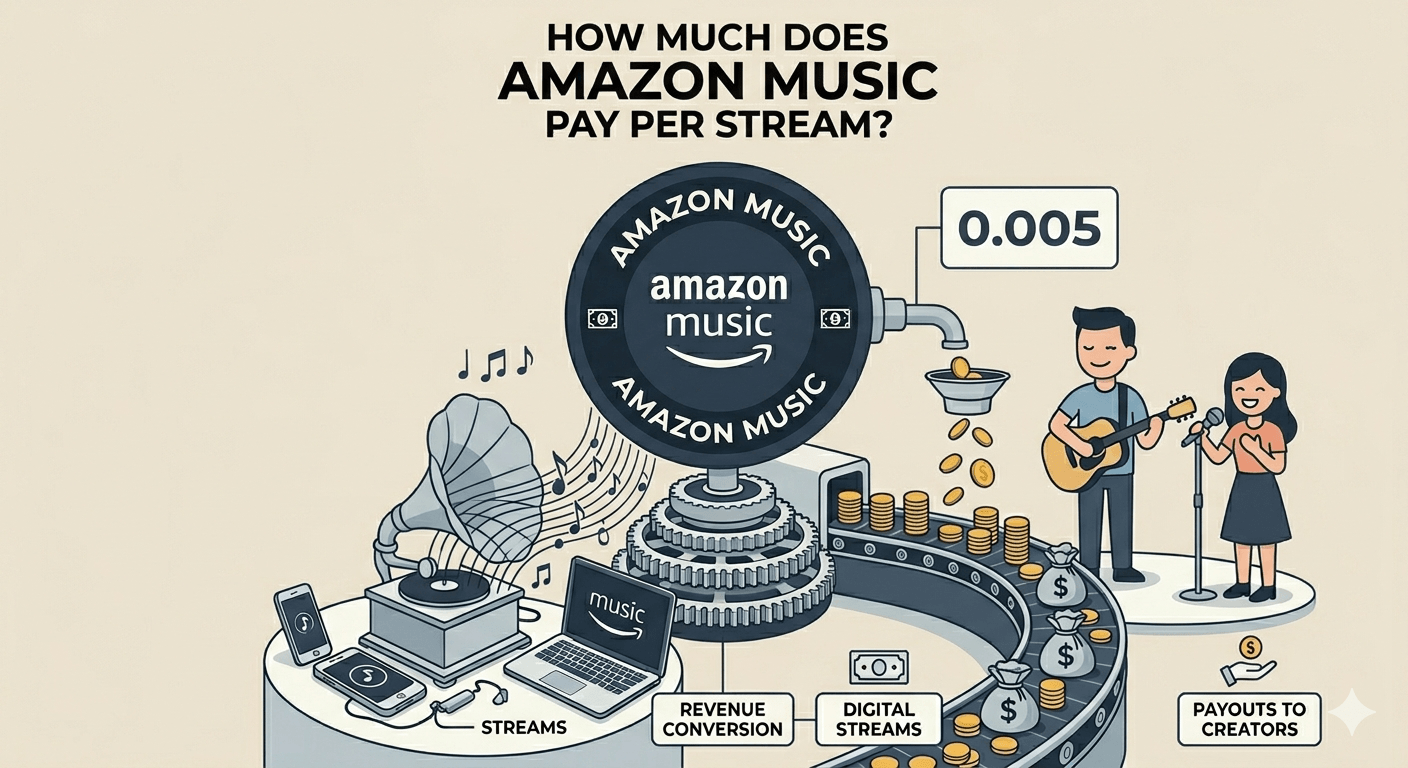
The straight answer: an average of ~$0.004 per stream in 2026 — but that number means almost nothing without knowing which tier your listeners are on. Amazon Music Unlimited HD can pay over $0.010. Prime Music can pay as little as $0.001. This guide explains every tier, variable, and strategy, with a live calculator built in.
Amazon Music pays an average of approximately $0.004 per stream in 2026, placing it above Spotify ($0.003–$0.005) on a blended basis. But unlike most platforms, Amazon operates multiple tiers with dramatically different rates: Music Unlimited HD/Ultra HD streams pay $0.004–$0.010+, standard Music Unlimited streams pay $0.004–$0.005, and Prime Music (bundled with Amazon Prime at no extra charge) pays only $0.001–$0.003 per stream.
The tier your listeners are on is the single most important variable in your Amazon Music royalty rate — more important than geography or engagement. Understanding this split is essential to interpreting your distributor statements accurately.
Amazon Music is the third-largest music streaming service in the world with over 110 million users, backed by the most powerful e-commerce and tech ecosystem on the planet. Yet most independent artists treat it as an afterthought — setting it up through their distributor and never thinking about it again. That’s a mistake, particularly for artists whose music lands on Prime Day playlists, Alexa radio, or Amazon’s editorial channels.


What makes Amazon Music uniquely complex is its multi-tier architecture. Three distinct listening products — Amazon Music Free, Prime Music, and Music Unlimited — share the same catalog but generate very different per-stream revenue. Understanding where your listeners actually sit in that structure is the key to understanding your royalty statement.
Amazon Music Earnings Calculator
Select your listener tier, adjust stream count and geography, and get a personalized monthly and annual estimate — plus a real-time comparison with Spotify, Apple Music, TIDAL, and YouTube Music.
Amazon Music’s 3 Tiers — and Why They Pay So Differently
Amazon Music is not a single product. It’s three overlapping products with the same catalog but completely different revenue economics for artists. The tier your listener is on determines how much you earn from their stream — potentially by a factor of 10.
The key insight: A US Music Unlimited HD subscriber stream is worth approximately 7–10× more than a free-tier stream in a low-CPM market. If your distributor shows a single “Amazon Music” number, you have no visibility into which tier your listeners are on. Amazon Music for Artists (the artist analytics dashboard) can break this down for you.
How Amazon Music Pays Artists
Amazon Music uses the same pro-rata royalty model as Spotify and Apple Music — with one important structural difference. It maintains separate revenue pools for Music Unlimited and Prime Music, which is why the two tiers pay such different per-stream rates.
Amazon Music Unlimited subscription fees feed one pool. Prime Music’s allocated share of Prime subscription revenue feeds a separate pool. Each pool is divided among streams from that tier only — so the per-stream rate for each tier is independent.
Amazon retains approximately 30–35% of music revenue as its platform fee. The remaining 65–70% is allocated to rights holders. Amazon’s cut is slightly lower than Spotify’s (~45%) and YouTube’s (~45%), which is part of why Music Unlimited rates are competitive.
Your share of each pool is proportional to your streams as a percentage of total streams in that pool that month. If your tracks account for 0.1% of all Music Unlimited streams in a month, you receive 0.1% of the Music Unlimited royalty pool.
Amazon Music’s algorithm gives additional weight to tracks with high completion rates, repeat plays, and playlist additions. Artists with highly engaged listeners effectively earn more per stream because their tracks are weighted more favorably in the pool calculation.
Amazon pays your distributor (DistroKid, TuneCore, CD Baby, Music Gateway, etc.) monthly. Your distributor passes royalties to you after their fee — 0% on flat-fee plans, 9–15% on percentage-based plans. Payment typically arrives 45–60 days after month-end.
Amazon Music for Artists dashboard: Unlike Spotify for Artists, Amazon’s analytics tool shows you real-time listening data including heat maps by geography, track-level retention, and — crucially — a breakdown by listener tier. If you haven’t connected your Amazon Music for Artists account through your distributor, do it now. It’s free and reveals exactly which tier your audience sits in.
Amazon Music Rates by Country: The Geography Gap
Just as with every streaming platform, where your listeners are located significantly affects your per-stream rate. Amazon’s subscription prices vary by country, and ad CPMs for the free tier are even more geographically variable.
| Country / Region | Music Unlimited rate | Prime Music rate | Tier |
|---|---|---|---|
| United States | $0.005–$0.010 | $0.002–$0.003 | Tier 1 |
| United Kingdom | $0.005–$0.009 | $0.002–$0.003 | Tier 1 |
| Germany / Australia | $0.004–$0.008 | $0.002–$0.003 | Tier 1 |
| Canada / France / Japan | $0.004–$0.007 | $0.001–$0.003 | Tier 2 |
| Mexico / Brazil | $0.002–$0.004 | $0.001–$0.002 | Tier 2 |
| India | $0.001–$0.003 | $0.0005–$0.001 | Tier 3 |
| Nigeria / Ghana / Kenya | $0.001–$0.002 | $0.0005–$0.001 | Tier 3 |
According to LabelGrid, a US HD listener on Music Unlimited is worth approximately 7× more per stream than an ad-supported listener in a low-CPM territory. This is the largest geographic multiplier of any major streaming platform, making geographic targeting particularly high-value for Amazon Music specifically.
Amazon Music vs Every Major Platform: 2026 Rate Comparison
Here’s where Amazon Music’s blended rate ($0.004) sits across the full competitive landscape. Note that the Amazon row represents an average across all tiers — your actual rate will be higher if your listeners skew toward Unlimited HD.
| Platform | Rate per stream | Per 1,000 streams | Relative rate | Free tier? |
|---|---|---|---|---|
| TIDAL | $0.010–$0.013 | $10–$13 | No — sub only | |
| Apple Music | $0.007–$0.010 | $7–$10 | No — sub only | |
| YouTube Music | $0.003–$0.015 (avg $0.0071) | $7.10 avg | Yes — ad tier | |
| Amazon Music ← | $0.001–$0.010 (avg ~$0.004) | $1–$10 | Yes — Prime & free | |
| Spotify | $0.003–$0.005 | $3–$5 | Yes — ad tier | |
| Audiomack | $0.001–$0.002 | $1–$2 | Yes |
The Amazon advantage: Amazon Music’s Music Unlimited HD tier actually rivals TIDAL for per-stream rates, making it the hidden high-payer in the mid-tier streaming landscape. Artists with a US-heavy audience of audiophile listeners — classical, jazz, folk, acoustic — tend to see disproportionately high Amazon Music royalties relative to stream count because these demographics skew toward Unlimited HD subscriptions.
How to Earn More From Amazon Music Without Getting More Streams
The biggest levers on your Amazon Music earnings aren’t about streaming volume — they’re about shifting your audience toward higher-paying tiers and higher-CPM markets. Here are six strategies that make a measurable difference:
Get your music earning more everywhere.
Music Gateway offers global distribution, sync licensing, Spotify playlist pitching, and Content ID registration — all in one platform. Trusted by 500,000+ artists.
Frequently Asked Questions
Verdict: Is Amazon Music Worth Prioritising?
Yes — and significantly more so than most independent artists realise. With over 110 million users, a competitive Music Unlimited rate that outpaces Spotify, HD streams that rival TIDAL for per-stream value, and a unique merch integration channel, Amazon Music deserves serious attention in your distribution strategy.
The key insight that most artists miss: not all Amazon Music streams are equal. A Music Unlimited HD stream from a US listener can pay 7–10× more than a Prime Music stream from a low-CPM market. Tracking which tier your listeners are on — through Amazon Music for Artists — and steering your promotion toward high-tier audiences is the highest-leverage action available to any artist on the platform.
Treat Amazon Music not just as a streaming platform but as an e-commerce-integrated revenue channel: streams, merch sales, and Prime Day editorial placements combine to make it unique among DSPs — and uniquely valuable for artists willing to engage with its ecosystem.
Join Our WhatsApp Channel
Follow us on Facebook to stay Connected
Join Our WhatsApp Group
For music uploads, promotions, and distribution inquiries, kindly contact 3musicGh via call or WhatsApp on +233 24 812 8217.
Our team is readily available to assist you with getting your music heard by the right audience.
DISCOVER & DOWNLOAD MORE SONGS BELOW
- How Much Does Apple Music Pay Per Stream
- How Much Does Amazon Music Pay Per Stream?
- How Much Does YouTube Music Pay Per Stream?
- Streaming Royalties Calculator | How Much Is Your Music Really Worth?
- How Much Does Audiomack Pay Per Stream?
- Top 10 Ghana Artists Dominating 2026 | Best Ghanaian Musicians Right Now
- 10 Most Streamed Ghanaian Artists on Audiomack 2026
- 10 Most Streamed Ghanaian Artists on Spotify 2026
- 10 Most Streamed Ghanaian Artists on YouTube 2026
- How To Monetizes Your Audiomack Account (AMP)
- List Of Countries With Monetization Access On Audiomack
- How To Become An Audiomack Authenticated Creator (Alternate Guide)
- How To Protect Your Music Copyright
- 10 Essential Music Performance Tips for Musicians