

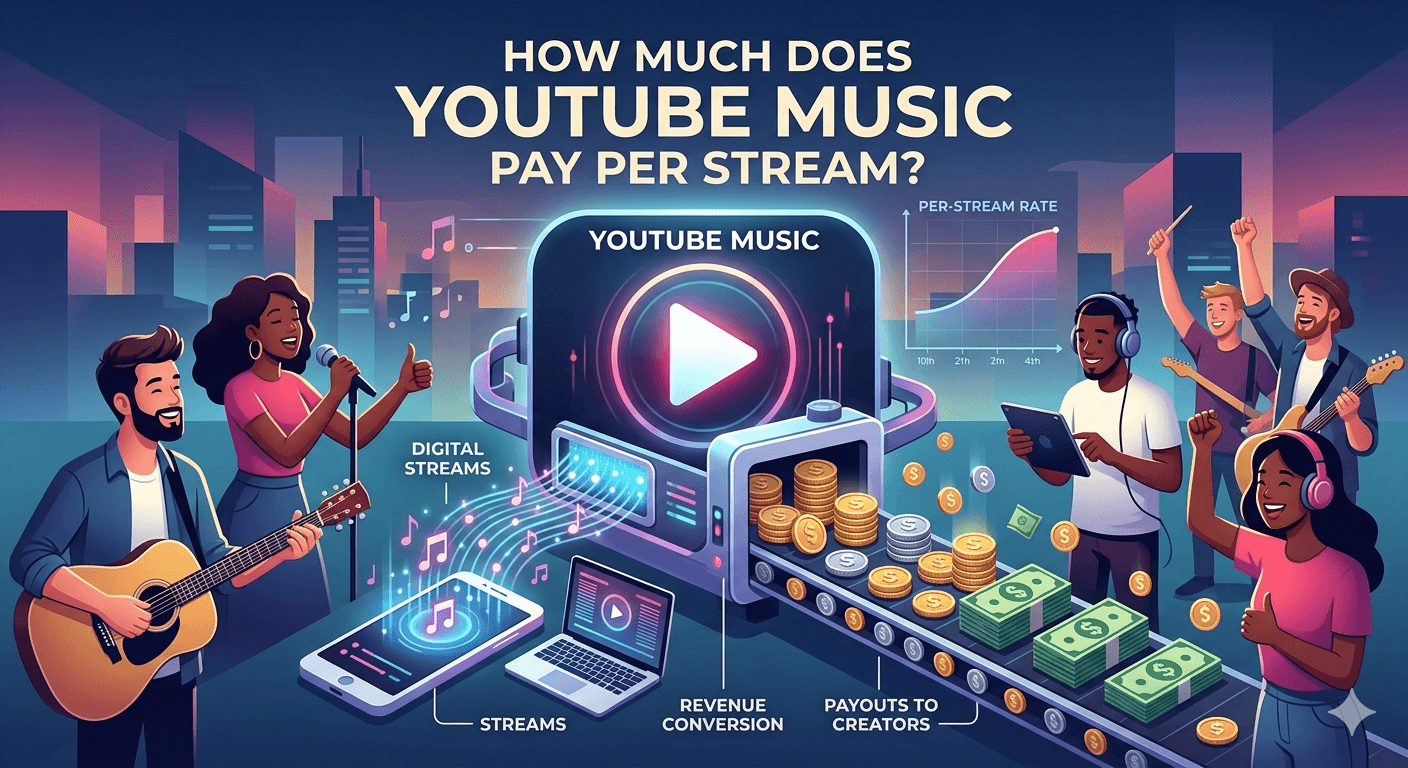
The honest answer: an average of $0.0071 per stream in 2026 — but that number swings from $0.0003 to $0.015 depending on four variables most artists have never checked. This guide breaks down every factor, platform by platform, country by country, with a live calculator built in.
YouTube Music pays a volume-weighted average of $0.0071 per stream in 2026, based on a sample of 5,127 streams from March 2025 (LabelGrid). The full distribution runs from roughly $0.0003 (5th percentile — ad-supported, low-CPM country) to $0.015 (95th percentile — premium subscriber, US/UK). Most independent artists see a blended effective rate of $0.002–$0.008 on their distributor statements once geography and tier mix are factored in.
Beyond streaming royalties, YouTube also pays through Content ID — approximately $0.00087 per monetized view on user-generated videos containing your music. This is a completely separate income stream on top of YouTube Music. For some artists, Content ID revenue exceeds their YouTube Music streaming royalties entirely.
YouTube Music is no longer the streaming afterthought it was in 2018. With 125 million paid subscribers as of 2026 and growing at roughly 2 million per month, it’s now the second-largest music streaming service by paid subscriber count — and its per-stream royalties have risen accordingly. Understanding how its payment system actually works is worth real money.


YouTube Music Earnings Calculator
Adjust for your stream count, audience geography, and premium/free mix to get a personalized monthly and annual earnings estimate — plus a live comparison with Spotify, Apple Music, TIDAL, and Amazon Music.
How YouTube Music Pays Artists
YouTube Music uses a pro-rata royalty model — the same foundational structure as Spotify and Apple Music. Every month, the total revenue YouTube generates from subscriptions and ads is pooled, YouTube takes its platform cut (~45%), and the remainder is allocated to rights holders in proportion to their share of total streams that month.
YouTube pools monthly subscription revenue from YouTube Music Premium and YouTube Premium subscribers ($11.99–$13.99/month in the US) with ad revenue from free-tier listeners. The two pools are kept separate internally and pay different rates.
YouTube retains approximately 45% of music revenue as its platform fee. The remaining ~55% flows to rights holders — labels, distributors, and publishers — as the overall music royalty pool.
Your streams as a percentage of total YouTube Music streams that month determines your share of the royalty pool. Your per-stream rate is not fixed — it is this pool divided by your stream count. As YouTube’s total stream volume grows, more revenue enters the pool too.
YouTube pays your distributor (DistroKid, TuneCore, CD Baby, Music Gateway, etc.) who then pays you after their fee — ranging from 0% on flat-fee plans to 15–20% on percentage-based plans. Major label artists typically see 15–25% of gross royalties after label recoupment.
YouTube Music pays distributors monthly. Most distributors release to artists 45–60 days post-month. January streams typically land in your account by mid-March.
Two separate line items: YouTube Music streaming royalties and Content ID revenue appear as separate entries on your distributor statement — or sometimes collapse into a single “YouTube” figure. If you only see one number, ask your distributor to break out YouTube Music audio streams vs. Content ID claims. They pay very differently.
Premium vs Ad-Supported: The Rate That Changes Everything
The biggest lever on your YouTube Music per-stream rate isn’t your stream count or your distributor — it’s the ratio of premium to free-tier listeners in your audience. The gap between the two tiers is dramatic.
📻 Free Tier (Ad-Supported)
- Pays ~$0.0008–$0.002 per stream
- Revenue driven entirely by ad CPMs
- Highly volatile — varies by country & season
- Q4 pays up to 50% more than Q1
- US streams = 3–5× more than low-CPM markets
⭐ Premium Subscribers
- Pays ~$0.005–$0.015 per stream
- Stable monthly subscription revenue
- Less volatile than ad-supported rates
- Scales with subscriber base (now 125M+)
- Outperforms Spotify Premium in some markets
The reason YouTube Music’s blended average has historically trailed Spotify despite having competitive premium rates is simple: YouTube’s free tier is enormous. YouTube as a platform has more than 2 billion monthly active users, many of whom discover music through free YouTube before ever subscribing to YouTube Music. As the paid subscriber base continues growing, the blended rate continues rising — which is exactly what we’ve seen in the data since 2022.
Practical implication: If you run paid promotional campaigns for your music, geo-targeting the US, UK, Germany, and Australia doesn’t just get you more streams — it specifically increases the proportion of premium listeners in your audience, which can raise your effective per-stream rate significantly without requiring additional stream volume.
Content ID: The YouTube Revenue Most Artists Leave Unclaimed
Content ID is YouTube’s automated copyright fingerprinting system. When anyone on YouTube — any of its 2+ billion users — uploads a video that contains your music (a travel vlog, a gaming stream, a workout video, a wedding highlight), Content ID detects it automatically and monetizes that video with ads on your behalf.
This is completely separate from YouTube Music. You can be earning Content ID revenue from a track that has never appeared on any streaming playlist — as long as someone somewhere used it in a YouTube video.
Content ID pays approximately $0.00087 per monetized view from user-generated content. Official YouTube channel video plays (your own uploads) average around $0.00164 per view. Both are lower than a direct YouTube Music stream — but the volume on UGC can be staggering. Chartlex estimates that 30–50% of independent artists’ YouTube revenue from Content ID goes uncollected because their tracks aren’t registered.
How to access Content ID
You cannot register directly with YouTube for Content ID — access is gated through approved distribution partners. Most major distributors handle this automatically when you distribute through them:
- DistroKid, TuneCore, CD Baby, AWAL, Amuse, Music Gateway — all include Content ID registration as part of their standard distribution service
- After distribution, any YouTube video using your music gets detected within 24–72 hours
- Revenue flows through your distributor’s dashboard, usually as a separate “YouTube Content ID” line item
- For older releases, check whether they were registered — pre-2019 releases often weren’t automatically enrolled
High-impact artists: According to Chartlex, some artists earn 5–10× more from Content ID claims than from their own channel’s views. This is especially true for artists whose music is popular with content creators — lo-fi, background instrumental, hip-hop beats, and ambient music in particular generate enormous passive Content ID income.
YouTube Music Rates by Country: Why Location Is the #1 Variable
Country of listener is the single largest driver of per-stream rate variance. Ad CPMs vary by 10–20× between the highest and lowest paying markets. Even premium subscriber rates have geographic variation because subscription prices differ by country. Here’s how markets tier out:
| Country | Est. rate / stream | Per 1,000 streams | Tier | Why it pays well |
|---|---|---|---|---|
| South Korea | ~$0.0105 | $10.50 | Tier 1 | High ad CPM ($10.51/1K views) |
| United States | $0.008–$0.015 | $8–$15 | Tier 1 | Highest global ad market, premium skew |
| United Kingdom | $0.006–$0.012 | $6–$12 | Tier 1 | High CPM, large premium subscriber base |
| Germany / Australia | $0.005–$0.010 | $5–$10 | Tier 1 | Strong advertiser markets |
| Canada / France / Japan | $0.004–$0.008 | $4–$8 | Tier 2 | Solid CPM, established streaming markets |
| Brazil / Mexico | $0.002–$0.004 | $2–$4 | Tier 2 | Large user base, lower CPMs |
| Nigeria / Ghana / Kenya | $0.001–$0.003 | $1–$3 | Tier 3 | Growing user base, lower ad market maturity |
| India / Pakistan / Bangladesh | $0.0005–$0.002 | $0.50–$2 | Tier 3 | Massive volume, very low CPMs |
The strategic implication: An artist with 100,000 monthly streams from US listeners earns roughly 3–5× more than an artist with the same stream count from listeners in India or Southeast Asia. This doesn’t mean ignoring global audiences — it means being strategic about which geographies you prioritize in paid promotion and playlist pitching.
YouTube Music vs Every Major Streaming Platform: 2026 Rate Comparison
Here’s where YouTube Music sits in the full competitive landscape. Note that the YouTube Music row covers streaming royalties only — add Content ID on top to get total YouTube revenue.
| Platform | Rate per stream | Per 1,000 streams | Rate vs Spotify | Free tier? |
|---|---|---|---|---|
| TIDAL | $0.010–$0.013 | $10–$13 | No — sub only | |
| Apple Music | $0.007–$0.010 | $7–$10 | No — sub only | |
| YouTube Music ← | $0.003–$0.015 (avg $0.0071) | $3–$15 | Yes — ad tier | |
| Amazon Music | $0.004–$0.008 | $4–$8 | Prime limited | |
| Spotify | $0.003–$0.005 | $3–$5 | Yes — ad tier | |
| Audiomack | $0.001–$0.002 | $1–$2 | Yes | |
| YouTube Content ID | ~$0.00087 | $0.87 | UGC / video |
The YouTube advantage no table captures: YouTube is the only platform that gives you three separate income channels from the same catalog — YouTube Music streaming royalties, Content ID revenue from UGC, and YouTube channel ad revenue (if you run an Official Artist Channel). No other DSP compounds revenue this way from a single release.
How to Earn More From YouTube Music Without Getting More Streams
Your per-stream rate isn’t negotiable — but your effective rate absolutely is. Six things you can do right now:
Maximize your music royalties — everywhere.
Music Gateway offers global distribution, Content ID registration, sync licensing, and Spotify pitch support — all in one platform. Trusted by 500,000+ artists worldwide.
Frequently Asked Questions
Verdict: Is YouTube Music Worth Prioritizing?
Yes — and increasingly so. YouTube Music’s average rate of $0.0071 now places it ahead of Spotify ($0.003–$0.005) in the streaming royalty rankings, and its subscriber base growing at 2 million per month signals continued upward pressure on rates through 2026 and beyond.
But the real case for YouTube isn’t just the streaming rate. It’s the compounded three-channel revenue model no other DSP offers:
- YouTube Music streaming royalties — paid through your distributor, ~$0.0071 average
- Content ID revenue — passive income from every UGC video using your music, ~$0.00087/view
- Official channel ad revenue — if you run a monetized YouTube channel (separate YPP eligibility required)
Stack all three, register every release for Content ID, optimize your metadata, and target high-CPM audiences in your promotion — and YouTube’s total revenue picture becomes one of the strongest in your distribution stack, regardless of what the single per-stream number looks like in isolation.
Join Our WhatsApp Channel
Follow us on Facebook to stay Connected
Join Our WhatsApp Group
For music uploads, promotions, and distribution inquiries, kindly contact 3musicGh via call or WhatsApp on +233 24 812 8217.
Our team is readily available to assist you with getting your music heard by the right audience.
DISCOVER & DOWNLOAD MORE SONGS BELOW
- How Much Does Apple Music Pay Per Stream
- How Much Does Amazon Music Pay Per Stream?
- How Much Does YouTube Music Pay Per Stream?
- Streaming Royalties Calculator | How Much Is Your Music Really Worth?
- How Much Does Audiomack Pay Per Stream?
- Top 10 Ghana Artists Dominating 2026 | Best Ghanaian Musicians Right Now
- 10 Most Streamed Ghanaian Artists on Audiomack 2026
- 10 Most Streamed Ghanaian Artists on Spotify 2026
- 10 Most Streamed Ghanaian Artists on YouTube 2026
- How To Monetizes Your Audiomack Account (AMP)
- List Of Countries With Monetization Access On Audiomack
- How To Become An Audiomack Authenticated Creator (Alternate Guide)
- How To Protect Your Music Copyright
- 10 Essential Music Performance Tips for Musicians